What We Do
Unlocking new insights on health trajectories through innovative statistical methods
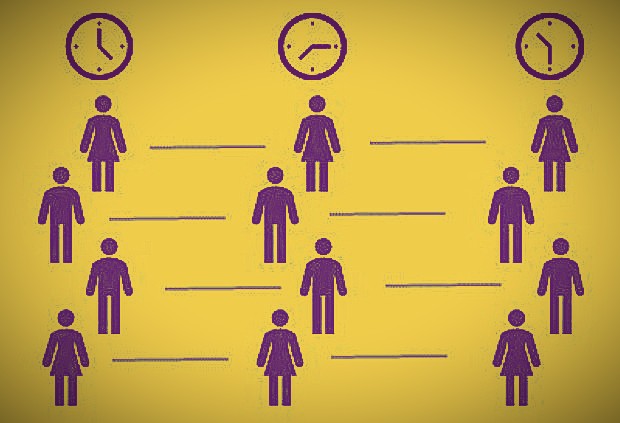
We develop, use, and promote innovative statistical methods to analyse repeated measures data in longitudinal studies to better understand how people grow and change throughout their lives.
Our work with trajectory modelling helps us to pinpoint critical moments when trajectories might change for the worse and identify factors that shape these paths. We also explore more dynamic features, such as rate of change over time, to gain deeper insights into growth and development.
Our Work
Methods Research and Training
Our methods research focuses on developing and improving trajectory modelling methods and creating easy-to-use software and guides to help researchers analyse how things change over time.
We use different techniques but primarily work with mixed effects models to build our trajectory models. These models are a powerful tool for understanding the typical trajectory of a population while also capturing the unique path of each individual. Other methods that we work with include latent growth curve models, latent trajectory models, and functional principal component analysis. We often use spline functions as part of our modelling to capture complex, non-linear patterns in data.
Example of our ongoing areas of research include:
-
Methods Comparisons: We conduct systematic comparison studies to evaluate and compare methods for modelling key trajectory features, such as the BMI peak and rebound, and adolescent mental health trajectory characteristics.
-
Methods Development: We’re enhancing SITAR (SuperImposition by Translation And Rotation) so that it can properly model body weight and other body size measures. We are also developing joint modelling approaches and multivariate models and exploring the use of machine learning methods for trajectory analysis.
-
Guidance and Tools: We are developing guides and software tools for using P-splines linear mixed effects models to analyse physical and mental health trajectories and key trajectory features.
-
Training We teach trajectory modelling at several University of Bristol’s MSc programs and Bristol Medical School Short Courses. Check out our Training page for more details and to access free introductory guides and tutorials.
Applied Research
Our ongoing applied research uses trajectory modelling and multinational cohort studies to understand how health evolves and to find answers that can improve life course health.
Some of our current research areas and interests include:
-
Understanding early life growth: We examine predictors, determinants and outcomes of infant, childhood, and pubertal growth patterns.
-
Effects of assisted reproductive technology: We collaborate with the ART-HEALTHPARTNERSHIP to examine health trajectories in people conceived using assisted reproductive technology.
-
Adolescent mental health: We study mental health trajectories and their determinants.
Data
The data we use come from various studies, including those shown below.
Funding
Our work is supported by funding from different sources, including the University of Bristol, MRC, Wellcome Trust, European Research Council, and Horizon Europe.