Adulthood weight gain and prostate cancer
New study examines relationship between weight trajectories and prostate cancer
Prostate cancer is the second most diagnosed cancer in men globally. It affects the prostate gland under the bladder and usually happens in men over 50 years old.
Obesity is an established risk factor for many cancers but the evidence for its effect on prostate cancer is inconsistent. One reason for the inconsistency may be because previous studies have generally only examined weight at a single timepoint without considering weight changes across adulthood, which might influence cancer risk independently of starting (baseline) body weight.
In a new study in the Journal of the National Cancer Institute, Marisa da Silva and colleagues find that adulthood weight gain was associated with reduced survival among those with a prostate cancer diagnosis. The researchers also found that adulthood weight gain appeared to reduce the risk of a prostate cancer diagnosis but that this was likely due to detection bias.
What the researchers did and found
The researchers followed-up 258,494 men in Sweden for up to 25 years tracking new cases of prostate cancer, including disease aggressiveness, and death. Longitudinal modelling was used to estimate individual weight trajectories between age 17 and 60 years.
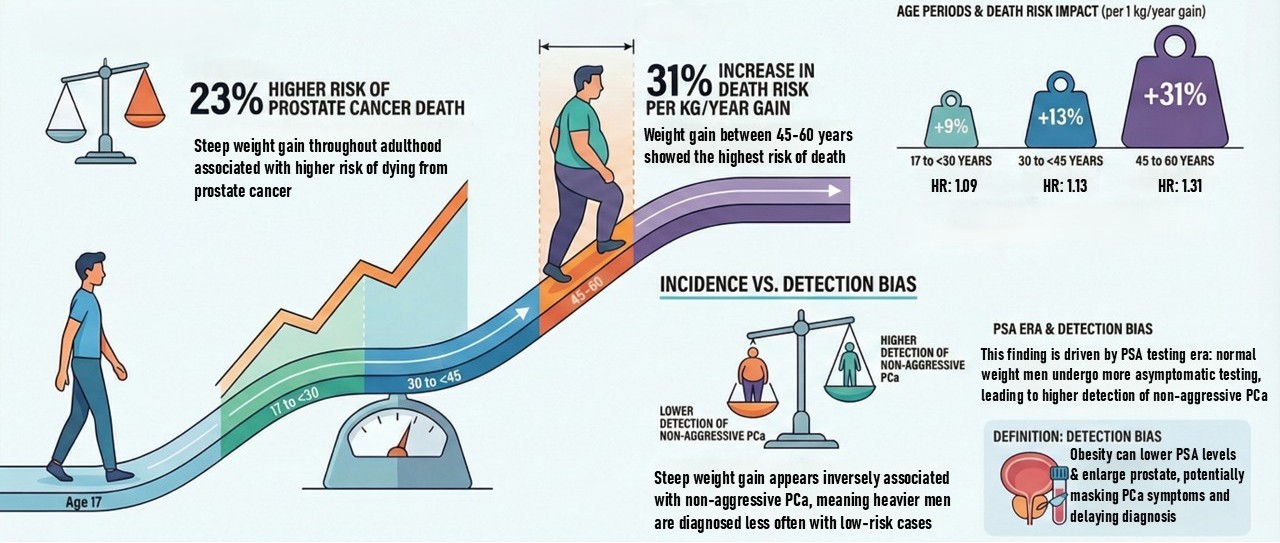
The study found that steep weight gain across adulthood was associated with lower risk of being diagnosed with non-aggressive prostate cancer. However, this was heavily concentrated in the modern era of prostate-specific antigen (PSA) testing and among asymptomatic cases, which suggests it is a result of detection bias because normal-weight men are more likely to undergo asymptomatic screening. Conversely, when looking specifically at men diagnosed with the disease, steep prediagnostic weight gain was associated with an increased risk of prostate cancer death. Moreover, this increased risk of death was primarily driven by weight gained in late midlife, between the ages of 45 and 60.
While the study benefits from a large sample size and trajectory analysis, notable limitations include the lack of data on some potential confounding factors, and the use of a predominantly ethnic Swedish sample in the study which limits how well the findings can be generalised to other populations globally.
What are the implications
This study shows that the timing of weight gain matters just as much as the amount, and points to weight gain during late middle adulthood as a distinct and actionable risk factor for disease survival, independent of how aggressive the tumour is at diagnosis.
It also highlights how opportunistic PSA screening can mask the relationship between weight and prostate cancer risk.
The life-course approach helps explain why previous studies using single-point weight measurements have produced conflicting results. Epidemiological research on adiposity and cancer must move beyond single exposure measurement and instead adopt life-course modelling to account for an individual’s adiposity trajectory.
More research is needed to understand the biological mechanisms that make late-onset obesity particularly detrimental to prostate cancer survival.
Key takeaway
While screening biases complicated the study of how weight gain might affect the chances of being diagnosed with prostate cancer, weight gain in late middle adulthood appears to increase the risk of dying from the disease. Clinical and public health guidelines should therefore explicitly acknowledge the importance of weight management and stability during the late midlife age window to help improve long-term prostate cancer outcomes.
Resources
-
Check out our training page for explanatory guides on mixed effects models and splines and for analysis tutorials